There is a genre of Caribbean music that has been quietly powering dance floors from Dominica to Paris, from Toronto to London — and most of the beatmaking world has barely heard of it.
Bouyon (pronounced boo-YON), also known as Jump Up, is one of the most high-energy, rhythmically complex genres to come out of the Eastern Caribbean. It is the kind of music that makes people physically unable to stand still. And for producers who discover it, it becomes an obsession.
The problem? Bouyon is almost invisible in the mainstream sample pack world. While hip-hop, Afrobeats, and even Kompa have growing representation in producer libraries, bouyon remains one of the most underserved genres in digital music production toolkits.
Producers who want to work in this space are largely on their own — forced to patch together sounds from kits that were never designed for Caribbean music.
That is changing. As the global appetite for Caribbean sounds grows — driven by diaspora communities, streaming algorithms, and a new generation of producers exploring non-Western rhythm structures — the demand for authentic bouyon samples is rising fast.
And the window to build in this space, both musically and from an SEO standpoint, is wide open.
🎁 Want to explore Caribbean sounds before diving in? Grab the free Mandragonbeat sample pack — Caribbean drum hits ready to load into any DAW, no cost, no commitment.
What Is Bouyon Music?
Bouyon was born in Dominica — the “Nature Isle” of the Caribbean — in the late 1980s and early 1990s. The genre emerged from a creative collision between multiple Caribbean traditions: the infectious rhythmic energy of soca, the melodic warmth of zouk, the raw attitude of dancehall, and the driving pulse of calypso.
The result is a genre that is entirely its own — faster, harder-hitting, and more percussively complex than any of its influences alone.
The name “bouyon” is Creole for “broth” or “stew” — a fitting metaphor for a genre that throws everything in the pot. Jump Up is its more commonly used international alias, a name that captures the genre’s defining physical instruction: when bouyon plays, you jump.
Several artists helped shape and spread the genre beyond Dominica’s shores. WCK (Windward Caribbean Kulture) are widely considered the pioneers of bouyon, developing the genre’s signature sound in the late 1980s.
Other key artists include Rough & Tough, Nasio Fontaine, and a generation of younger Dominica-based acts who have pushed the sound into the digital era. The Dominica Carnival — known as one of the most authentic carnival experiences in the Caribbean — has been the primary incubator for bouyon’s evolution.
What makes bouyon distinctive beyond its rhythm is its cultural purpose. It is community music, built for collective celebration, for carnival, for moments when the boundary between performer and audience dissolves.
This communal energy is embedded in the music’s DNA — and producers who want to capture it authentically need to understand this cultural context, not just the technical characteristics.
Today, bouyon is expanding beyond Dominica. Caribbean diaspora communities in the UK, France, Canada, and the United States have carried the genre into new environments. Streaming platforms and social media have given it global reach.
And a small but growing community of producers outside the Caribbean are discovering its potential — both as a genre to produce authentically and as a rhythmic influence to blend with other styles.
The Rhythm DNA of Bouyon
Understanding bouyon from a production standpoint requires getting familiar with its rhythmic architecture. This is not a genre you can approximate by adjusting the tempo on a hip-hop kit. Bouyon has its own rhythmic logic, and every element of the drum pattern serves a specific function within that logic.
Tempo: 120-145 BPM. Bouyon operates at a significantly higher tempo than most Caribbean genres. While Kompa rolls comfortably at 110-125 BPM and Shatta sits around 100-115 BPM, bouyon pushes into the 120-145 BPM range — and some of the most energetic Jump Up tracks run even faster.
This elevated tempo creates the genre’s signature breathless urgency, the feeling that the music is always pulling you forward.
The Kick Pattern. The bouyon kick is thunderous and punchy — designed for outdoor sound systems and festival environments where the bass needs to cut through open air and dense crowds. The pattern typically features a strong downbeat kick with syncopated secondary hits that create a rolling, relentless momentum.
Unlike hip-hop kicks that often sit back in the pocket, the bouyon kick drives forward aggressively.
Syncopated Bass Lines. The bass in bouyon is not a simple root-note follower. It plays a highly syncopated, melodic pattern that weaves between the kick hits, creating a rhythmic conversation between low-end elements.
This bass-kick interplay is one of the most distinctive features of bouyon production and one of the most challenging to recreate without the right source material.
Brass and Horn Stabs. Traditional bouyon arrangements feature prominent brass sections — trumpet, trombone, and saxophone hits that punctuate the rhythmic pattern with sharp, high-energy stabs. In contemporary bouyon production, these are often recreated with brass samples or VST instruments, but the rhythmic placement and tonal character remain essential to the genre’s identity.
Live Percussion Layers. Bouyon’s percussion section draws from the full Caribbean tradition: congas, bongos, steel pan hits, cowbells, shakers, and hand percussion fills. These layers add the organic, human feel that gives bouyon its sense of communal energy.
Getting this percussion right is one of the biggest differentiators between a convincing bouyon riddim and something that merely sounds tropical.

Why Bouyon Samples Are So Hard to Find Online
If you have spent any time searching for bouyon samples online, you already know the answer to this question from personal experience. The cupboard is almost bare. Here is why.
The niche is massively underrepresented. The sample pack industry has followed the money — and for decades, the money has been in hip-hop, EDM, Afrobeats, and Latin music. Genres that originate from smaller island nations, regardless of their musical depth and richness, have been systematically overlooked.
Bouyon, originating from Dominica (population roughly 70,000), has had essentially no commercial representation in mainstream producer libraries. The few “Caribbean” sample packs that do exist are typically soca-oriented at best, and generic tropical at worst.
Generic Caribbean samples miss the mark entirely. When a mainstream sample company does release a “Caribbean” pack, the results are usually disappointing for anyone who actually knows the music. You get steel pan loops, a few soca-adjacent percussion hits, and maybe some beach-vibe atmospheres.
None of this captures the rhythmic specificity of bouyon — the particular kick character, the syncopated bass patterns, the precise placement of percussion hits that define the genre. Using these samples to make bouyon is like trying to make Afrobeats with a country drum kit.
Authenticity requires insider knowledge. Bouyon samples do not just need to be high quality — they need to be culturally accurate. The difference between a kick that sounds Caribbean and a kick that sounds like bouyon is subtle but critical.
It requires the ear of someone who has grown up with the music, who has felt it at Dominica Carnival, who understands intuitively when a hi-hat swing is right versus when it is slightly off. This kind of knowledge cannot be faked or approximated by a producer who has never encountered the genre.
The documentation gap. Unlike hip-hop or EDM, bouyon has very little written production documentation available online. There are no widely-read tutorial articles, no YouTube series on bouyon beat-making, no forums dedicated to the genre’s production techniques.
This makes it nearly impossible for producers outside the Caribbean community to learn the genre’s rhythmic language — even if they had access to the right samples.
This is precisely why the Bouyon God Drumkit Vol.1 represents something genuinely new in the Caribbean music production space.
For more context on Caribbean music production tools, see the Caribbean Drum Kit Bundle overview and the guide on how to make Kompa beats — two related resources that round out the picture of Caribbean genre production.
What to Look for in a Quality Bouyon Sample Pack
Not all sample packs are created equal, and when it comes to a genre as specific as bouyon, the quality criteria matter more than usual. Here is what separates a genuinely useful bouyon drum kit from something that will frustrate you after the first session.
24-bit WAV format. This is the non-negotiable starting point. 24-bit WAV files give you greater dynamic range and more headroom in your mix compared to 16-bit or MP3 formats. When you are layering multiple percussion elements — which bouyon requires — that extra headroom means cleaner, more professional results with less distortion and artifact buildup.
Any bouyon sample pack worth your money should deliver 24-bit WAV as standard.
Royalty-free licensing. You are buying these samples to make music you intend to release. Make sure the pack’s license allows commercial use — including streaming releases, sync licensing, and physical distribution — without additional fees. Read the small print: some cheaper packs have restrictive licenses that limit commercial use or require attribution.
For professional production, you need true royalty-free samples that give you full creative freedom.
Genre-specific variety. A quality bouyon sample pack should offer a comprehensive range within the genre — not just a handful of kicks and one or two snares.
You need multiple kick variations (different tonal characters, different transient profiles), a full hi-hat library (closed, open, pedal, rolls), layered snare options, an extensive percussion section covering congas, bongos, shakers, cowbells, and steel pan hits, and ideally some transition and FX samples for arrangement.
Variety within the genre is what enables creative exploration without forcing you to reach for inappropriate sounds from other kits.
Clear file organization. Studio time is expensive, whether in real money or in creative momentum. A well-organized sample pack — with files sorted by category and clearly labeled — means you spend time making music, not hunting through poorly named folders.
Look for packs where the organization reflects actual production workflow: kicks in one folder, snares in another, percussion grouped logically.
Cultural authenticity. This is the hardest criterion to verify before purchase, but it is the most important for bouyon specifically. Look for packs created by producers with genuine ties to Caribbean music — not outsiders approximating the sound. The difference in the final product is audible.
Bouyon God Drumkit Vol.1 — 807 Samples Reviewed in Detail
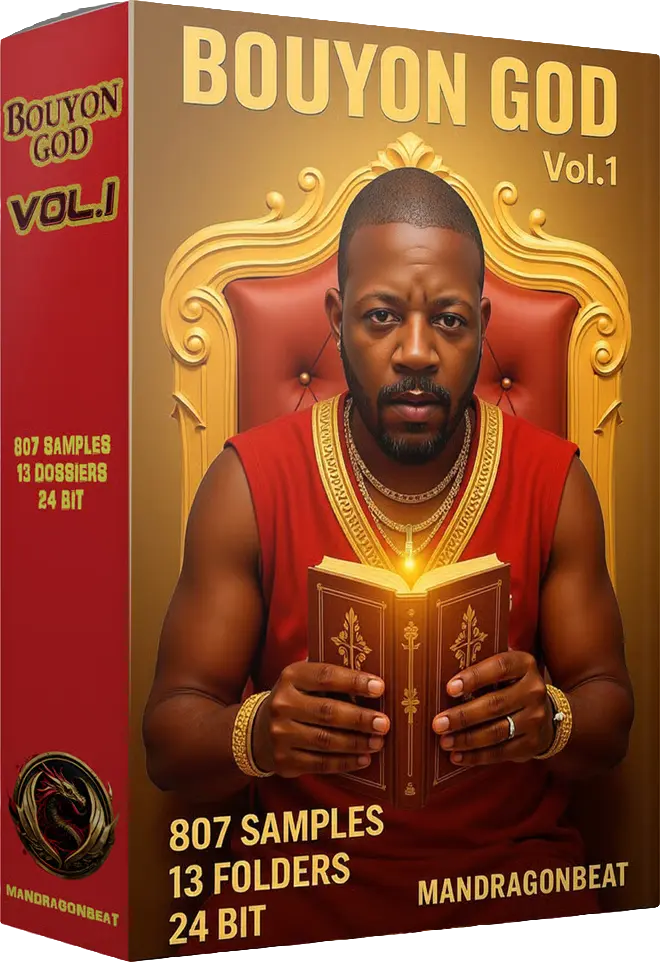
The Bouyon God Drumkit Vol.1, available from the Mandragonbeat store, is the largest kit in the Caribbean production lineup — 807 royalty-free samples covering the full rhythmic vocabulary of bouyon and Jump Up production. Here is what is inside.
807 royalty-free samples in 24-bit WAV. This is not a curated selection — it is a comprehensive library.
The sheer sample count reflects the genre’s rhythmic complexity: bouyon production requires more variety than most genres because the layered percussion architecture demands multiple character options at every level of the kit. 807 samples ensures you will never find yourself repeating the same sound in a way that betrays the genre’s organic feel.
Kicks — Explosive and Festival-Ready. The kick collection is built for bouyon’s most demanding production context: outdoor festival sound systems where the bass needs to carry across open air. The kicks are punchy and explosive with a fast transient attack and a tight, controlled low-end that translates across different playback systems.
Multiple kick variations are included to cover different bouyon styles and tempos — from the rolling, relentless patterns of classic Jump Up to the more aggressive, angular kicks used in contemporary bouyon fusion.
Snares — Bright, Sharp, and Cut-Ready. Bouyon snares are not hip-hop snares. They are bright and sharp, designed to cut through dense arrangements built on fast 16th-note percussion grids.
The Bouyon God Drumkit provides a full range of snare characters: tight rimshots for classic riddim structures, open snaps for more contemporary sounds, and layered snare combinations that give you the flexibility to build a custom snare sound that fits your specific track.
Hi-Hats — 16th-Note Precision. The hi-hat collection is calibrated for bouyon’s elevated tempo range. At 130 BPM+, hi-hat patterns need to be tight, precise, and capable of driving the rhythmic momentum without crowding the frequency spectrum.
The kit includes closed hi-hats in multiple velocity layers, open hi-hats with varying decay lengths, pedal hits for rhythmic accents, and roll patterns for transitions and fills. Velocity layering is particularly important here — it is what makes fast 16th-note hi-hat patterns sound natural rather than robotic.
Percussion — The Soul of the Kit. This is where the Bouyon God Drumkit earns its reputation.
The percussion section is the most extensive in the entire Mandragonbeat catalog: congas in multiple pitches and playing styles (open tone, muted tone, slap), bongos, timbales, steel pan hits, cowbells in different sizes and tones, shakers, cabasas, and hand percussion fills and rolls.
These are not generic tropical percussion samples — they are recorded and processed specifically for bouyon production, with the tonal character and dynamic response that the genre requires.
FX and Transitions. The kit also includes a selection of risers, downlifters, and percussion transition fills — essential tools for building the dynamic arc of a bouyon arrangement.
These elements are often overlooked in sample packs but are critical for professional-level bouyon production, where the arrangement needs to build tension and release energy at specific moments.
Full DAW compatibility. All samples are standard 24-bit WAV files compatible with every major DAW: FL Studio, Ableton Live, Logic Pro X, Pro Tools, GarageBand, Cubase, Studio One, and any other application that accepts WAV audio. No proprietary formats, no plugins required — download, unzip, and load directly into your sampler or drum machine.
5 Beat Ideas You Can Build With This Kit Today
One of the best ways to understand a sample pack’s creative range is to think concretely about what you can build with it. Here are five beat ideas that demonstrate the versatility of the Bouyon God Drumkit Vol.1 — each one a genuinely different direction you can take these 807 samples.
1. Classic Jump Up Riddim. Set your tempo to 138 BPM. Build a continuous 16th-note hi-hat grid with strong velocity accents on beats 1 and 3 and lighter ghost hits on the in-between 16th notes. Place an explosive kick on beat 1 and a secondary syncopated kick on the “and” of beat 2.
Add a bright snare on beats 2 and 4. Layer congas on the offbeats and add a shaker running 8th notes at low volume. The result is a textbook Jump Up riddim foundation that feels instantly authentic.
2. Contemporary Bouyon Fusion. Bring the tempo down slightly to 128 BPM and use the more angular, punchy kicks from the collection. Pair them with a trap-influenced hi-hat pattern (triplet rolls, stutters) layered on top of the traditional bouyon percussion grid. Add Caribbean brass stabs on the offbeats.
This kind of fusion beat sits comfortably between bouyon and global bass music — perfect for producers who want to introduce Caribbean energy to audiences familiar with Afrobeats or UK Drill.
3. Bouyon Carnival Anthem. Push the tempo to 142 BPM and build the most energetic pattern possible using the kit’s fastest hi-hat rolls and most explosive kicks. Layer two or three conga patterns simultaneously — the rhythmic density is intentional, reflecting carnival’s communal percussion tradition.
Use the steel pan hits as melodic accents every two bars. This is festival music at its most physical.
4. Bouyon x Soca Hybrid. At 130 BPM, combine the bouyon kick and snare patterns with a rolling soca-style horn stab arrangement. Use the bouyon percussion library for the rhythm section foundation and add melodic percussion (steel pan, cowbell) in the soca pattern positions.
This hybrid captures the cross-pollination that has always characterized Eastern Caribbean music and creates something genuinely new while remaining culturally rooted.
5. Bouyon Instrumental Showcase. Use the full percussion range of the kit to build a layered instrumental that demonstrates the genre’s rhythmic complexity without any electronic elements. Congas, bongos, shakers, steel pan, and cowbells — all from the Bouyon God Drumkit — arranged into an interlocking pattern that evolves over eight bars.
This kind of beat works as a standalone instrumental, as a loop for video content, or as a production demo that shows potential collaborators what you can do with authentic Caribbean sounds.
FAQ — Bouyon Samples and Production
Q: What are bouyon samples and why are they different from generic Caribbean samples?
A: Bouyon samples are drum and percussion sounds specifically designed for bouyon (Jump Up) music production — the high-energy Caribbean genre originating from Dominica. They differ from generic Caribbean samples in their tonal character, rhythmic specificity, and cultural authenticity.
Generic “tropical” or “Caribbean” sample packs typically draw from soca, reggae, or ambiguous island sounds. Bouyon samples are engineered for the genre’s specific tempo range (120-145 BPM), its punchy kick character, its syncopated percussion patterns, and its dense rhythmic layering requirements.
Q: What BPM should I use for bouyon beats?
A: Bouyon and Jump Up music typically sits between 120 and 145 BPM. Classic bouyon riddim patterns are most common in the 130-140 BPM range, which gives the music its characteristic breathless, high-energy momentum.
Contemporary bouyon fusion beats sometimes drop to 120-128 BPM to blend more easily with Afrobeats and dancehall-influenced production. If you are producing for the first time, start at 132 BPM — it is a central tempo that captures the authentic bouyon feel while remaining manageable for learning the rhythmic patterns.
Q: Can I use bouyon drum samples in commercial music releases?
A: Yes, provided your samples carry a royalty-free license.
The Bouyon God Drumkit Vol.1 is 100% royalty-free, meaning once you purchase the kit you can use the samples in unlimited commercial projects — streaming releases on Spotify, Apple Music, and Tidal; sync licensing for film, TV, and advertising; and physical releases — without paying any additional fees.
The standard restriction applies: the raw samples themselves cannot be resold or redistributed as part of another sample pack.
Q: Is bouyon music growing in popularity outside the Caribbean?
A: Yes, and significantly. The Caribbean diaspora in the UK, France, Canada, and the United States has been the primary driver of bouyon’s international spread, maintaining strong demand for the genre outside its Dominica homeland.
More recently, streaming algorithms and social media have given bouyon wider exposure to audiences with no prior Caribbean connection. Producers exploring non-Western rhythm structures — many coming from Afrobeats, global bass, and world music production backgrounds — are increasingly discovering bouyon as a genre with enormous untapped creative and commercial potential.
Conclusion: Get the Authentic Bouyon Sound You’ve Been Looking For
Bouyon is a genre that rewards the producers who take the time to understand it. Its rhythmic complexity, its cultural depth, and its raw physical energy make it one of the most compelling sounds in Caribbean music — and one of the most exciting production territories available to forward-thinking beatmakers right now.
The barrier has never been talent or creativity. It has always been access to the right tools. With the Bouyon God Drumkit Vol.1 — 807 royalty-free samples in 24-bit WAV, organized for real workflow efficiency, and built by a producer with deep roots in Caribbean music — that barrier is gone.
➡️ Get the Bouyon God Drumkit Vol.1 on Etsy and start making authentic Caribbean beats today.
🎁 Going deeper into Caribbean production? The Caribbean Drum Kit Bundle combines the Bouyon God Drumkit with the Kompa God Drumkit and the Shatta God Drumkit — over 1,500 samples across three complete genre kits — at a significant discount versus individual purchases.
If your production ambitions span the full Caribbean spectrum, the bundle is the smarter investment and the most comprehensive starting point available anywhere.
The energy is there. The tools are there. Now it is time to make the music.
1 thought on “Best Bouyon Samples for Producers: How to Get That Authentic Caribbean Energy”
Comments are closed.