A finished Shatta riddim passes ten checks — from tempo and kick pattern to mono compatibility and reference loudness. Print this checklist, run every beat through it, and your consistency will jump overnight. Here is the full production path from idea to bounce.
Phase 1: Foundation (Checks 1-3)
✔ 1. Tempo locked between 95-105 BPM
Set it before anything else; Shatta’s pocket lives in this range.
✔ 2. Kick pattern uses broken subdivisions
The 3+3+2 cell or a variation. Straight four-on-the-floor is Bouyon’s job, not Shatta’s.
✔ 3. Rim answers the kick
Bone-dry rimshot syncopation. If you mute the rim and the groove survives, the rim is not doing its job.
Phase 2: Identity (Checks 4-6)
✔ 4. Snare lands on the 3 with attitude
Clipped, mid-forward, clap layered underneath tuned darker.
✔ 5. One dark melodic cell, maximum two
A minor-key pluck or stab. If you have four melodic layers, delete two — minimalism is the genre.
✔ 6. Percussion fills the pocket, not the spectrum
Metallic ticks and short congas between kick hits. Solo the drums: every sound should be identifiable.
Phase 3: Arrangement (Checks 7-8)
✔ 7. Something changes every 8 bars
Mute, fill, FX or flip. Shatta is drop-driven — build the wave.
✔ 8. Bar before each drop is nearly silent
Silence is the genre’s loudest weapon; use it before every impact.
Phase 4: Technical (Checks 9-10)
✔ 9. Low end survives mono
Sum to mono: if the kick loses weight, fix phase before mixing further. Our guide to layering Shatta drums covers the phase-checking method.
✔ 10. Loudness referenced against a released riddim
A/B at matched volume. Close the gap with saturation and clipping, not just limiter squeeze.
Stack the Deck Before You Start
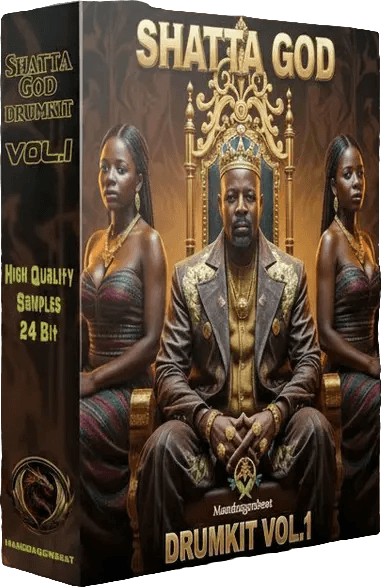
Half these checks pass automatically when your source sounds already fit the genre. The Shatta God Drumkit Vol.1 was assembled so its 62 sounds pass the identity checks out of the box — royalty-free, WAV 24-bit, club-tested.
FAQ
How long should a Shatta riddim be?
Club versions run 2:30-3:30. Keep an extended DJ intro/outro version too — selectors are your best distribution channel.
Should I master my own Shatta beats?
For leases and demos, a clean limiter chain is enough. For commercial releases, a dedicated master (yours or outsourced) pays for itself in playability.
What key do Shatta melodies usually use?
Minor keys dominate — the darker the better. F minor and G minor are workhorses, but the pattern matters more than the key.
How do I know my riddim is finished?
Run the checklist: groove locks in mono, drops hit without clipping, arrangement moves every 8 bars, vocal space stays clear, and the file plays loud next to a released reference.
Ten checks, one riddim at a time — that is how consistency becomes a reputation.