Something has been happening in global music over the last five years that most mainstream producers have been slow to notice.
A genre born from the intersection of Jamaican dancehall and Francophone African street culture — shatta — has been quietly climbing charts, racking up hundreds of millions of streams, and shaping the sound of an entire generation of urban music across Côte d’Ivoire, Cameroun, the French Antilles, and beyond.
Shatta Wale turned it into a brand. Ivorian and Cameroonian artists pushed it into the French-speaking mainstream. Caribbean producers blended it with zouk roots and created something entirely new.
And now, beatmakers everywhere are trying to work in this space — only to discover that finding the right shatta drum kit is harder than it should be.
This guide covers everything you need to know: what shatta music actually is, how it differs from standard dancehall, what the key production elements are, and where to find the only drum kit built specifically for this sound.
If you want to make beats that actually feel like shatta — not just dancehall-adjacent — you are in the right place.
🎁 New to Caribbean production? Start with the free Mandragonbeat sample pack — authentic Caribbean drum hits ready to load into any DAW, no cost required.

What Is Shatta Music?
Shatta is a genre that is easier to feel than to define — but let us try anyway, because the definition matters enormously for production.
At its core, shatta is a fusion genre that takes the rhythmic skeleton of Jamaican dancehall and runs it through the sonic filter of Francophone African and Caribbean musical culture.
The result is a sound that carries dancehall’s characteristic riddim structure — the syncopated kick patterns, the heavy bass presence, the DJ-style vocal delivery — but layers on top of it the melodic warmth, the rhythmic nuance, and the cultural references of West African and French Caribbean music traditions.
The word “shatta” itself has multiple contested origins. In the Ghanaian context, it is strongly associated with the artist Shatta Wale, who built a global profile from Accra and brought the sound to international attention.
But the genre as a distinct production style — particularly the French Caribbean and Francophone African variant — developed somewhat independently, drawing from local musical traditions that had already been absorbing and transforming Jamaican dancehall influences for decades.
Key artists who have shaped the shatta sound:
Shatta Wale (Ghana) is the most internationally recognized name in the ecosystem, with collaborations with Beyoncé and a massive West African fanbase. His production style draws heavily from Jamaican dancehall while incorporating Highlife and Afrobeats elements.
DJ Arafat (Côte d’Ivoire), who pioneered “couper décaler” music with strong shatta influences before his death in 2019, remains one of the most important figures in shaping the genre’s Ivorian character. Stanley Enow and Mr. Leo (Cameroun) represent the Cameroonian branch of the sound, blending shatta rhythms with Bikutsi and Makossa influences.
In the French Antilles — Martinique and Guadeloupe — artists have fused shatta with zouk and local carnival music, creating a distinctly Caribbean variant that is increasingly influential across the French-speaking diaspora.
What unites all these strands is the fundamental rhythmic identity: a dancehall-derived beat structure that has been adapted, transformed, and made culturally specific by each regional community that has adopted it. For producers, this means shatta is not a single fixed sound — it is a rhythmic framework that carries enormous creative range.
The Sound of Shatta — Key Production Elements
Understanding shatta at the production level means breaking down its component parts. Here is what defines the sound from a beatmaker’s perspective.
Tempo: 90-110 BPM. Shatta sits in a mid-tempo range that distinguishes it from both the faster pace of bouyon (120-145 BPM) and the slower groove of Kompa (110-125 BPM). This tempo range creates a heavy, swinging feel — danceable but deliberate, with space for the bass and kick to breathe.
The 95-105 BPM zone is the sweet spot for most shatta production.
The Shatta Kick. The kick in a shatta beat is heavy and resonant — a deep, low-end dominant sound that sits in the sub frequencies and physically moves air at club volume. Unlike hip-hop kicks that often have a punchy mid-range attack, the shatta kick prioritizes sub weight.
It typically follows a simplified dancehall pattern — heavy on the downbeats with strategic syncopated variations — but its tonal character is distinctly different from Jamaican dancehall kicks, carrying a warmer, more rounded low-end profile.
The Hi-Hat Triplet Pattern. This is one of shatta’s most recognizable production signatures. The hi-hat pattern in shatta frequently employs triplet subdivisions — a rolling, three-against-two feel that gives the groove its characteristic bounce and makes it feel simultaneously heavy and light.
This is not a feature of standard dancehall production, which tends to work in straight 16th-note subdivisions. The triplet hi-hat is a key differentiator that gives shatta its distinctive Afro-Caribbean rhythmic character.
The Rolling Bass. The bass line in shatta is melodic and rolling — it does not just follow the kick but plays an independent melodic pattern that weaves through the rhythmic space. This is influenced by zouk bass playing and Afrobeats bass production, both of which emphasize melodic bass movement over simple root-note patterns.
Getting the bass right is essential to the shatta sound and is one of the areas where producers using generic dancehall kits most often go wrong.
Siren and FX Stabs. Shatta production frequently employs siren-type synthesizer hits, horn stabs, and brass FX as rhythmic punctuation elements. These hits — often placed on the two and the four, or on specific offbeat positions — add drama and intensity to the arrangement.
They are borrowed from Jamaican dancehall’s love of siren sounds but have been adapted in shatta to carry a more melodic, less aggressive character.
Vocal Chops and Samples. Contemporary shatta production regularly uses short vocal chop samples — typically single syllables or short phrases processed into rhythmic hits — as additional percussive elements. These vocal textures add human warmth and cultural specificity to the rhythm section and are a key part of the modern shatta sound.

Shatta vs Dancehall: What’s the Difference for Producers?
This is one of the most frequently searched questions in the shatta production space — and for good reason. The relationship between shatta and dancehall is close enough to cause confusion but different enough to make the distinction matter enormously at the production level.
Origin and cultural context. Dancehall is a Jamaican genre with roots in the late 1970s and early 1980s, born from the sound system culture of Kingston.
Shatta is a derivative genre that developed primarily in West and Central Africa and the French Caribbean, taking dancehall’s rhythmic framework and adapting it to local musical cultures and languages. They share DNA but are distinct traditions.
Tempo and feel. Standard Jamaican dancehall typically runs between 75 and 90 BPM — slower than most people expect — with a specific “one drop” or “steppers” rhythmic feel. Shatta typically runs faster, 90-110 BPM, and has a more rolling, continuous rhythmic momentum that reflects its Afrobeats and zouk influences.
Kick character. Dancehall kicks are often sharp and punchy with a mid-range attack that cuts through a mix. Shatta kicks lean heavier — more sub-dominant, warmer in the low-mids, built for the French Caribbean and African club sound system context rather than the Jamaican sound system tradition.
Hi-hat patterns. As noted above, the triplet hi-hat is a shatta signature that does not appear in standard dancehall production. This rhythmic difference alone is enough to make a standard dancehall kit sound wrong in a shatta context.
Melodic elements. Shatta production is generally more melodically dense than classic dancehall, reflecting the influence of zouk (which is a highly melodic genre) and Afrobeats (which emphasizes melodic interplay between instruments). Dancehall arrangements are often more rhythmically focused with sparser melodic content.
Language and vocal delivery. Dancehall vocals are typically delivered in Jamaican Patois, with DJ-style toasting. Shatta vocals are delivered in French, Nouchi (Ivorian French slang), Cameroonian Pidgin, or Antillean Creole — a linguistic difference that shapes the melodic phrasing and rhythmic flow of the vocal parts and, by extension, the production style that supports them.
For producers, the takeaway is clear: you cannot make authentic shatta with a dancehall kit, any more than you could make authentic Kompa with a hip-hop kit. The sonic and rhythmic specifics matter, and they require purpose-built tools.
Why Generic Dancehall Kits Don’t Work for Shatta
If you have tried to make shatta beats using a standard dancehall sample pack, you have already lived the frustration. The sounds are close — but not close enough. Here is exactly why generic dancehall kits fail for shatta production.
The kick is the wrong shape. Dancehall kicks are built for the Jamaican sound system tradition — punchy, mid-forward, cutting. Shatta kicks need to be built for a different acoustic environment and a different low-end expectation. The sub weight, the transient character, and the tonal processing are all different.
Using a dancehall kick in a shatta track creates a subtle but persistent wrongness that trained ears notice immediately and that undermines the cultural authenticity of the production.
The hi-hat patterns are the wrong subdivision. A standard dancehall kit gives you straight 16th-note hi-hats. Shatta’s triplet hi-hat feel requires samples that were recorded and processed for that specific rhythmic application. Forcing straight-subdivision hi-hats into a triplet pattern context produces a mechanical result that lacks the organic swing of real shatta production.
The percussion vocabulary is missing. Generic dancehall kits typically lack the Caribbean and Afrobeats percussion elements that give shatta its distinctive warm, organic texture. The congas, the shaker patterns, the hand percussion fills drawn from zouk and Afrobeats traditions — none of this is present in a standard dancehall sample pack.
Cultural specificity cannot be simulated. Shatta, like all the genres in the Caribbean and Francophone African production tradition, has a sonic character that was shaped by specific musical cultures over decades. The way samples are recorded, processed, and mixed in a shatta context reflects knowledge that comes from inside the tradition.
Producers working from outside that tradition with inappropriate tools can approximate the surface features of the sound — but the result will always lack the depth and authenticity that makes the music genuinely move people.
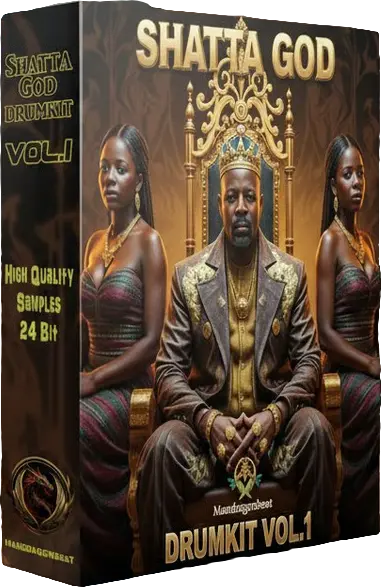
This is the gap that the Shatta God Drumkit Vol.1 was built to fill. For further context on authentic Caribbean production tools, see the complete Caribbean Drum Kit Bundle overview, the guide on making Kompa beats, and the resource on the best bouyon samples for producers.
Shatta God Drumkit Vol.1 — 59 Precision-Crafted Samples Reviewed
The Shatta God Drumkit Vol.1, available from the Mandragonbeat store, takes a deliberately different approach to sample kit design.
Where the Bouyon God Drumkit (807 samples) and Kompa God Drumkit (650 samples) prioritize comprehensive variety, the Shatta God Drumkit is a precision collection of 59 meticulously crafted samples — every single one earning its place.
Quality over quantity — and here is why that philosophy works. Shatta production, more than most genres, is about the interaction between a small number of carefully chosen elements.
A shatta beat is not built from dozens of layered percussion hits — it is built from the precise combination of the right kick, the right hi-hat feel, the right bass character, and the right FX elements.
A smaller, better-curated kit that gets these elements exactly right is more valuable for shatta production than a larger kit full of sounds that are only approximately correct.
24-bit WAV format. Every sample is delivered in 24-bit WAV — the industry standard for professional music production. This means maximum dynamic range, full frequency representation, and no compression artifacts to deal with at the mixing stage.
When you are working with a precision kit of 59 samples where each one needs to perform perfectly, 24-bit quality is non-negotiable.
The Kicks — Sub-Heavy and Built for the Dance Floor. The kick collection captures the specific low-end character that defines shatta production: deep, warm, and resonant in the sub frequencies, with a controlled transient attack that drives the groove without cluttering the mid-range.
Multiple kick variations are included — different degrees of sub depth, different transient shapes for different production contexts — giving you the flexibility to choose the exact kick character your track needs.
The Hi-Hats — Triplet-Ready and Rhythmically Alive. This is the most technically demanding part of any shatta drum kit, and the Shatta God Drumkit delivers it precisely. The hi-hat samples are recorded and processed specifically for the triplet subdivision feel that defines the genre.
Both closed and open varieties are included, with velocity nuance that makes programmed patterns feel organic rather than mechanical. Getting this right is the single most important factor in making a beat that sounds like shatta rather than like dancehall with a faster tempo.
Snares and Rims — Tight and Punchy. The snare collection provides the mid-range authority that keeps a shatta beat driving. These are not the fat, open snares of hip-hop or the bright, cracking snaps of bouyon — they are tight, punchy, and precisely tuned to sit in the frequency pocket that a shatta arrangement requires.
Rimshot variations are included for producers who want to add the rhythmic accents typical of Caribbean and Afrobeats-influenced production.
Percussion and FX. The kit includes a curated selection of percussion hits — shakers, cowbells, and hand percussion — drawn from the zouk and Afrobeats traditions that have shaped the shatta sound. Siren-style FX hits and transition elements round out the collection, giving you the dramatic punctuation tools that are essential for modern shatta arrangement.
100% royalty-free. All 59 samples can be used in unlimited commercial releases — streaming, sync, physical — with no additional licensing fees. The only restriction, standard across all professional sample packs, is that the raw samples cannot be resold or redistributed.
Full DAW compatibility. Standard 24-bit WAV files work in every major DAW: FL Studio, Ableton Live, Logic Pro X, Pro Tools, GarageBand, Cubase, Studio One, and any other application that accepts WAV audio. No proprietary formats, no plugins required.

From Starter to Pro — Pairing Shatta God With the Caribbean Bundle
The Shatta God Drumkit at 39,99€ is the most accessible entry point in the Mandragonbeat catalog — a focused, professional-quality kit that gives you everything you need to start producing authentic shatta immediately. For producers who are new to Caribbean music or who primarily work in shatta, it is the natural first purchase.
But if your production ambitions extend beyond shatta — if you want to work across the full spectrum of Caribbean music, or if you want to understand how shatta connects to the broader Caribbean production tradition — the Caribbean Drum Kit Bundle represents a fundamentally different level of investment.
What the bundle adds: The Caribbean Bundle combines the Shatta God Drumkit with the Kompa God Drumkit (650 samples) and the Bouyon God Drumkit (807 samples) — giving you over 1,500 royalty-free samples across the three most important genres in Caribbean music production. The combined individual retail value of the three kits is 147€.
The bundle brings all three together for 89,99€ — a saving of over 57€.
The creative case for the bundle. Beyond the financial savings, the bundle has a creative logic that is particularly relevant for shatta producers. Shatta exists at the intersection of Caribbean musical traditions — it draws from zouk, from carnival music, from the same rhythmic DNA as Kompa and Bouyon.
Having all three kits means you can blend elements freely: a Kompa kick under a shatta hi-hat pattern, bouyon percussion textures in a shatta arrangement, cross-genre combinations that no producer working with separate libraries from different sources could easily achieve.
The sonic cohesion between all three Mandragonbeat kits — built by the same producer with the same philosophy — makes this kind of blending natural and musically convincing.
Future-proofing your workflow. Caribbean music is one of the fastest-growing areas of global music production right now. The diaspora communities that have driven these genres are producing more music than ever, streaming platforms are amplifying Caribbean sounds globally, and producers outside the Caribbean are discovering these genres with increasing frequency.
Having the full Caribbean production toolkit positions you to work in any direction the music takes you — today and in the years ahead.
The Caribbean Drum Kit Bundle is available now for 89,99€.
FAQ — Shatta Drum Kit and Production
Q: What is a shatta drum kit and what makes it different from a dancehall kit?
A: A shatta drum kit is a collection of drum and percussion samples specifically designed for shatta music production — the Francophone African and Caribbean genre that fuses Jamaican dancehall rhythms with Afrobeats, zouk, and local Caribbean and West African musical influences.
It differs from a standard dancehall kit in its kick character (heavier sub, warmer low-end), its hi-hat patterns (triplet-subdivision-ready rather than straight 16th-note), its percussion vocabulary (drawing from Afrobeats and zouk traditions), and its overall tonal character (more melodically warm, less aggressively punchy than Jamaican dancehall).
Q: What BPM should I use to make shatta beats?
A: Shatta production typically sits in the 90-110 BPM range, with the 95-105 BPM zone being the sweet spot for most styles.
This mid-tempo range gives the music its characteristic heavy, swinging groove — fast enough to drive a dance floor, slow enough for the sub-heavy kick and rolling bass to breathe.
French Antilles shatta variants sometimes run slightly slower (88-95 BPM) to accommodate the zouk influence, while contemporary shatta fusion tracks may push toward 110 BPM to sit comfortably alongside Afrobeats and Afropop production.
Q: Can I use a shatta drum kit to make Shatta Wale type beats?
A: Yes — the rhythmic vocabulary of a properly constructed shatta drum kit covers the production elements used in Shatta Wale-influenced production. The key elements are the heavy sub kick, the triplet hi-hat feel, and the rolling bass character.
However, it is worth noting that Shatta Wale’s production draws from multiple influences including Afrobeats and Ghanaian Highlife in addition to dancehall — so the full sonic range of that sound may require supplementing a shatta drum kit with additional melodic and harmonic elements from Afrobeats-specific libraries.
Q: Is shatta music growing internationally, and is it worth producing in 2025?
A: Absolutely. Shatta is one of the most significant emerging genres in global urban music right now.
The Francophone African music ecosystem — driven by artists from Côte d’Ivoire, Cameroun, Senegal, and the DRC — has become one of the most commercially dynamic areas of the global music industry, with streaming numbers that rival Afrobeats and reggaeton in key markets.
The French Caribbean shatta variant is growing rapidly within the large French-speaking diaspora communities in Europe and North America. For producers looking to work in an area with genuine market growth potential and relatively limited competition in the sample pack space, shatta represents one of the strongest opportunities available in 2025.
Conclusion: Get the Shatta Sound Right — From the First Beat
Shatta is not a trend — it is a genre with deep cultural roots, a growing global audience, and a production tradition that rewards authenticity.
The producers who succeed in this space are the ones who take the sound seriously: who understand its rhythmic DNA, respect its cultural origins, and use tools that were built for the music rather than approximations borrowed from adjacent genres.
The Shatta God Drumkit Vol.1 gives you 59 precision-crafted, royalty-free samples in 24-bit WAV — every one of them designed specifically for authentic shatta production, by a Caribbean producer who understands the genre from the inside out.
➡️ Start making authentic shatta beats today: Get the Shatta God Drumkit Vol.1 on Etsy — 39,99€. Professional quality, correct sound, immediate download.
🎁 Want the complete Caribbean toolkit? The Caribbean Drum Kit Bundle combines the Shatta God Drumkit with the Kompa God Drumkit (650 samples) and the Bouyon God Drumkit (807 samples) — over 1,500 royalty-free samples for 89,99€ instead of 147€. Save 57€ and get the full spectrum of Caribbean production sounds in one purchase.
The sound is right here. Make the music you have been hearing in your head.